Profitable Engineering
Transforming Technology Teams Into Strategic Business Partners
What if your technology organization stopped defending its cost and started proving its value? Profitable Engineering helps leaders connect Flow and Realization so technology teams don't simply produce more output, but create measurable business value across the entire value stream. It shows why many delivery problems are not talent problems or practice failures. They are leadership and operating-model problems.
Make work visible. Make value measurable.
Also available in paperback at:



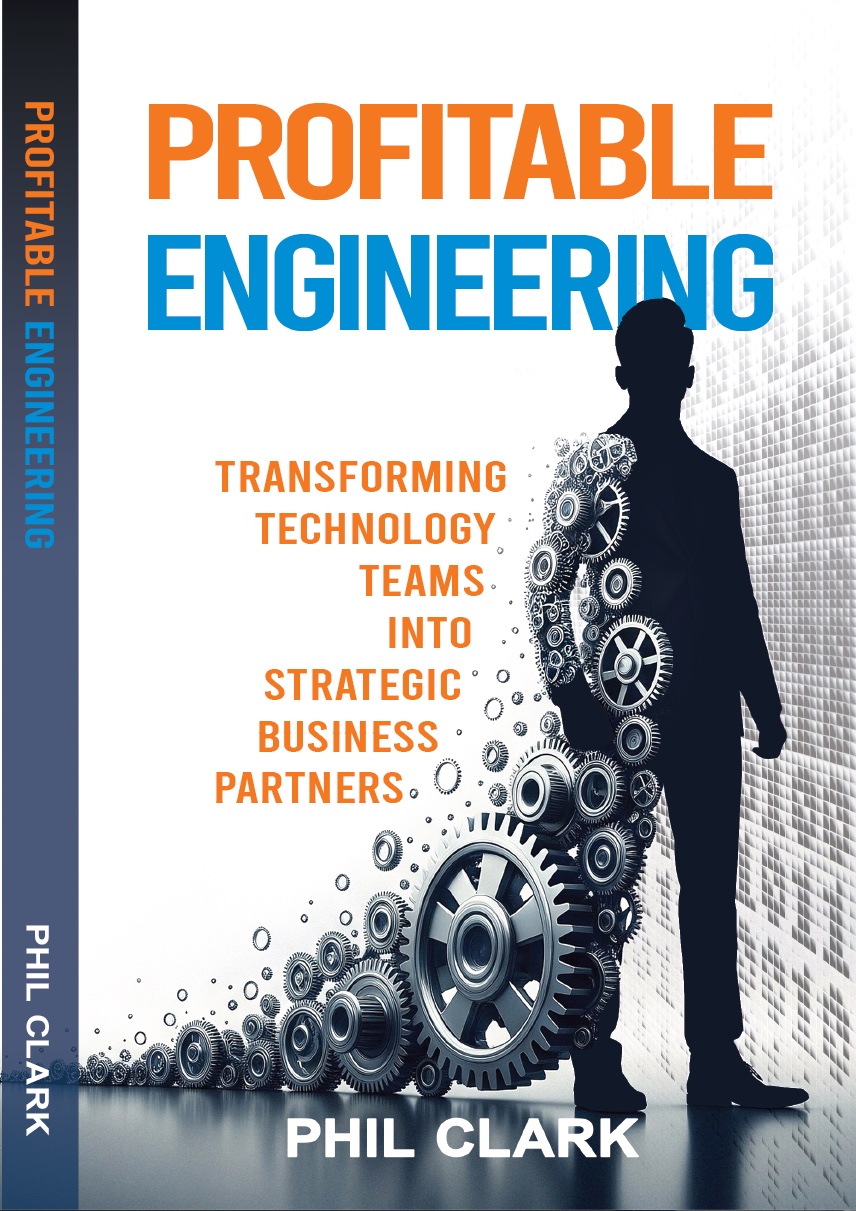
Profitable Engineering
(noun)The discipline of leading technology not as overhead to be minimized, but as a strategic asset where efficiency drives margin and customer outcomes drive growth.
The synchronization of Flow and Realization: shipping fast with high quality, to deliver solutions that positively impact customer behavior and business results.
— from the opening pages of Profitable EngineeringWho This Book Is For
Profitable Engineering is written for the leaders accountable for Product and Technology:
These are the people expected to move faster, prove value to the business, lead through AI-enabled change, and build Product and Technology organizations that talented people want to join, trust, and stay with.
If your board wants speed, your CFO wants efficiency, your customers expect value and reliability, your teams need focus and stability, and AI is changing how work gets done, this book was written for you.
It's also a valuable read for engineering managers, product managers, architects, and team leads who want to understand how leadership decisions shape the systems that determine how technology delivers value.
A leadership playbook drawn from real-world experience in complex organizations.
Why This Book Now
The pressure on technology teams has changed. Shipping is no longer enough, and AI has made that truth harder to ignore.
AI tools and agents can accelerate parts of design, coding, testing, analysis, support, and operations. But acceleration does not equal strategy. More generated work does not automatically create customer value, lower cost-to-serve, reduce risk, improve reliability, or build teams people trust and want to stay on.
In an AI-enabled organization, the leadership problem becomes more important: what work should be automated, what requires human judgment, how outputs should be validated, how risk should be governed, and how faster delivery should be connected to realized outcomes.
Most organizations have increased delivery pressure without improving the system that delivery runs on. AI can amplify that pattern. Without better governance, measurement, and clarity, it can help teams produce more work without proving whether any of it mattered.
Profitable Engineering offers a practical leadership model for this era: make value visible, govern Flow and Realization, use AI responsibly, and build Product and Technology organizations where people and intelligent tools improve the system together.
The question is no longer only: Can we move faster?
The better question is:
Can we build a technology organization where AI-enabled work creates measurable value, human judgment remains strong, and great people want to stay?
What if your teams could move fast without heroics, and the business could see the value?
Profitable Engineering is built around Flow + Realization. Flow helps leaders see how work moves through the value stream. Realization asks whether that work produced measurable value. Together, they help organizations avoid becoming faster feature factories and instead connect engineering investment to outcomes the business can see.
Flow
How you deliver
Make invisible work visible. Surface waiting and friction so teams can move value steadily, without heroics.
Funding
How you align incentives
Shift from project-cost thinking to outcome-based investment. Fund products for long-term learning instead of resetting momentum every quarter.
Realization
How you know whether the work mattered
Connect anticipated outcomes to actual outcomes after release. Move beyond "features shipped" to evidence that the investment changed customer behavior, operational performance, risk, cost-to-serve, or business results.
AI
How you scale capability
AI amplifies whatever system it touches. Anchor adoption in literacy, guardrails, and measurement so it multiplies clarity, not confusion.
The missing financial language between engineering and the business
Profitable Engineering shows leaders how to connect investment, flow, and realized outcomes so technology is no longer defended through activity reports alone.
It introduces a practical way to review value streams through cost, delivery movement, risk, and business impact, giving executives a clearer way to govern technology as an ongoing investment.
More Than a Framework
Most leadership books explain frameworks. Few explain the conditions that make them work under real business pressure. Profitable Engineering shows how funding, team design, flow visibility, value measurement, and AI adoption reinforce each other in practice.
Where other books hand you a framework and wish you luck, this one focuses on the practical conditions that let teams find flow, take ownership, make better decisions, and deliver outcomes the business can see and measure.
This is not a book about making teams look busier. It is about helping leaders see whether technology investment is moving, whether it is producing value, and whether the operating model is strong enough to sustain both.
From the Book
“AI will amplify whatever system it touches. Strong systems gain leverage. Weak systems gain noise.”
— On AI Adoption
“Every team can ship faster. Few can prove that what they shipped was worth funding.”
— On Realization
“You do not need faster people. You need fewer things slowing good people down.”
— On Flow
Early Praise for Profitable Engineering
“This book is a rare look into the mind of a leader who understands that while technology changes, the principles of trust, flow, and value remain constant. It challenges old assumptions and offers a clear path for those ready to lead with both courage and care.”
Bob Langan
Former SVP of Engineering, Parchment Inc.
“First-hand wisdom distilled from decades of experimentation, unlearning, and relearning. When I need to make sense of the chaos, I return to the core components found in this book: Flow and Realization. Where are we trying to get to, and how are things moving right now?”
Steve Pereira
Founder of Visible; Author, Flow Engineering
“Profitable Engineering is more than a guide. It is an essential manifesto for anyone ready to lead their organization toward a more purposeful, flow-oriented, and profitable future.”
Helen Beal
Founder, Flowtopia.io; Fractional CEO.
“Phil's core idea, Flow + Realization, is deceptively simple: it's not enough to see how work moves, you have to ask whether it actually created value. His book stays close to the leader as the unit of change. It's less blueprint, more mirror. If you're a tech leader trying to shift how your organization is seen, from cost center to strategic driver, put this on your list.”
Maik Hassel
Deep-Tech Product, Organization, and Operating Model Leader (via LinkedIn)
What You'll Take Away
Through Flow and Realization, the book shows how modern practices, product alignment, and durable team design improve flow and make business value more visible.
- See where value stalls before delivery slips.
- Connect Flow metrics to realized business outcomes.
- Fund durable teams without resetting momentum every quarter.
- Translate engineering work into language executives and finance leaders can act on.
- Use Value Stream thinking to expose cost, risk, and return.
- Adopt AI with literacy, guardrails, and measurement instead of hype.
This is the operating manual for making technology a strategic advantage, not a cost to be managed.
A Note from Phil
I wrote this book because people I respect kept telling me I should. For years, colleagues, vendor partners, and fellow leaders encouraged me to put these lessons into writing. Eventually, I listened.
I'm glad I did. Writing Profitable Engineering became a chance to capture what I have lived through firsthand: the successes, the mistakes, the hard lessons of transformation, and the patterns I have seen in other leaders building high-performing technology organizations.
This book comes from experience earned inside the work. I have lived through both the legacy era of software delivery and the modern shift toward Agile, DevOps, Value Stream Management, and outcome-driven leadership. Along the way, I learned that technology creates the most value when leaders stop treating it like a cost center and start leading it as a strategic business partner.
If you are in that seat now, under pressure, short on time, and trying to bring clarity to complexity, this book was written for you.

About The Author
Phil Clark is a senior technology leader known for building high-performing engineering organizations where trust, accountability, and continuous improvement strengthen both people and performance.
Shaped by multiple eras of software delivery, from waterfall and big-batch releases to continuous delivery, product operating models, and AI-assisted engineering, he brings a leadership perspective informed by both legacy constraints and modern delivery practices.
He has helped leaders modernize systems, improve cross-functional alignment, and turn software delivery into a measurable business advantage.
Through Rethink Your Understanding, he collaborates with and advises technology executives on building the leadership practices and delivery systems that drive lasting business impact.
His work has consistently focused on creating operating models where teams move fast without heroics, quality remains strong, and business outcomes become more visible and actionable.
Profitable Engineering captures the playbook behind that work: Flow + Realization, durable team ownership, platform guardrails, and metrics that connect delivery to business value, leaders can see and act on.
Built from real operating experience
Phil's work is shaped by hands-on leadership across multiple eras of software delivery, from waterfall and big-batch releases to product operating models, continuous delivery, Value Stream Management, and AI-assisted engineering.
During his tenure at Parchment (later acquired by Instructure), the technology organization scaled across 10 countries while supporting approximately 55 million annual transactions, more than 3,000 annual production changes, near 99.99% uptime, and strong retention of high-performing talent.
Get in Touch
Have a question about the book, want to discuss your engineering challenges, or interested in speaking and collaborating? I'd love to hear from you.